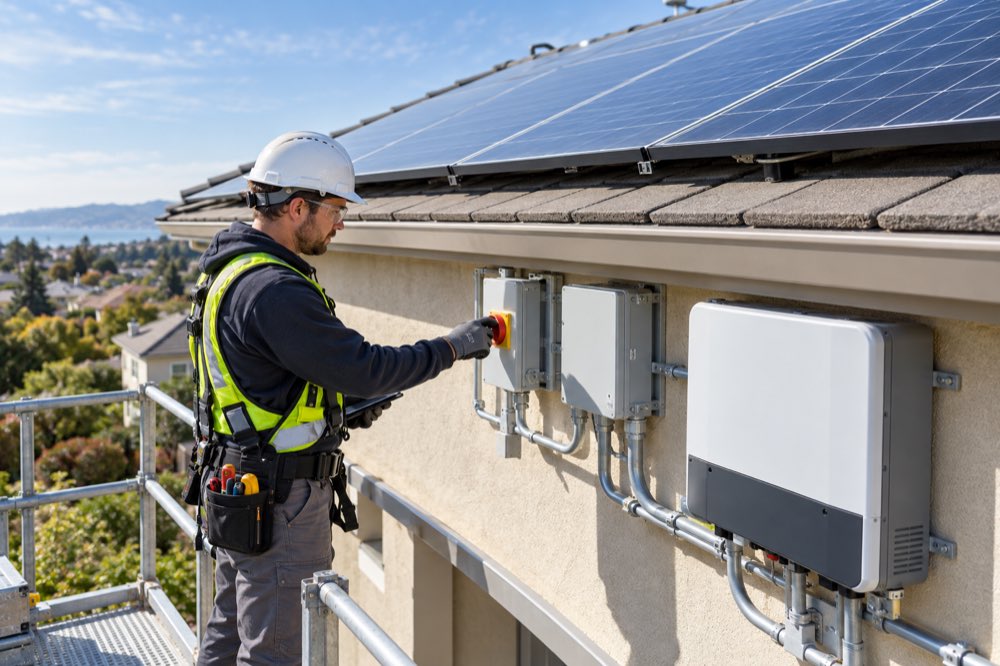
Qualified electrician inspecting solar rapid shutdown equipment

The update of 2017 of the NEC (National Electric Code) is now law in 30 states in the country as of NEC January 2020. The remaining states are currently in the process of adding the new rules to their current legislation.

By complying with the NEC of 2017, this means that any solar installation on any building must have the proper capacity of being able to quickly shut down in case of an emergency. This is known as module-level rapid shutdown.

These rule applies to PVs mounted on buildings, but it does not include solar carports because they are not considered buildings. Instead, solar carports are considered to be shelters.

There are several ways that solar installers can ensure that they are in compliance with the 2017 NEC.

Install A Field Labeled Or Listed Rapid Shutdown System

‘Listed’ is a term that derived from the first name that was given to the UL’s certification program that was developed over 100 years ago. The NEC uses this term, but it does not mention any systems or products that must have UL certification.

The rule instead discusses the types of organizations that would be able to perform this type of certification service. It has been suggested that manufacturers certify their products so they will be able to meet the rapid shutdown specifications given by UL. However, other testing labs that are nationally recognized could possibly be alternatives.

During the Solar Power International Conference in 2019, there were many rapid shutdown device and inverter manufacturers present that displayed their certifications with SunSpec. Even though SunSpec has developed specific protocols that allow for communication with different types of rapid shutdown equipment, it is not like UL. It is not a listed body.

The Installation Of A BIPV System That Does Not Have Metal Parts, No Conductors Exposed And More Than 8 Feet Of Grounded Metal

Solar tiles, shingles and other types of BIPV (PV)integrated systems meet the 2017 NEC requirements only if they do not have any metal parts, they are not located near grounded metal or have any exposed conductors. These systems must remain separate from any components that are conductive and grounded.

Install A Solar Energy System That Is Able To Reduce Its Voltage To 80 V Within A Minute

Microinverters are usually compliant with the rapid shutdown rule because they are able to change high-voltage power into low-voltage power in less than a minute. The lower voltage power is able to go down to around 80-V in less than half of a minute.

On the other hand, the NEC of 2017 does not mention microinverters specifically when discussing ways to be in compliance with rapid shutdown requirements.

There are some microinverters that have been designed to have capacitators that are located on the front part of the circuitry. This means that unless there is a voltage measurement done by an experienced inspector, it will be difficult to know if the microinverter is really under the 80-V restriction.

UL has been performing these types of tests regularly in order to provide verification as to whether specific microinverters are able to meet the threshold set by the NEC of 80-V. However, it is difficult to assess the information from this type of testing after the inverters are installed.

A revised edition of the NEC that is scheduled to be released in 2020, it will likely focus less on previous rules and focus more on the requirements for rapid shutdown.

So, is rapid shutdown the same as total shutdown? And how fast is rapid? Rapid shutdown is not an entire shut down of the system. This is why ‘PV Hazard Control’ was created as a way to help consumers better understand what is really being accomplished when discussing that type of protection.

Understanding the different necessities that are in place for solar installation in a certain jurisdiction is an ideal starting point to ensure that you will have a successful installation that is approved by the governing agency in the area.
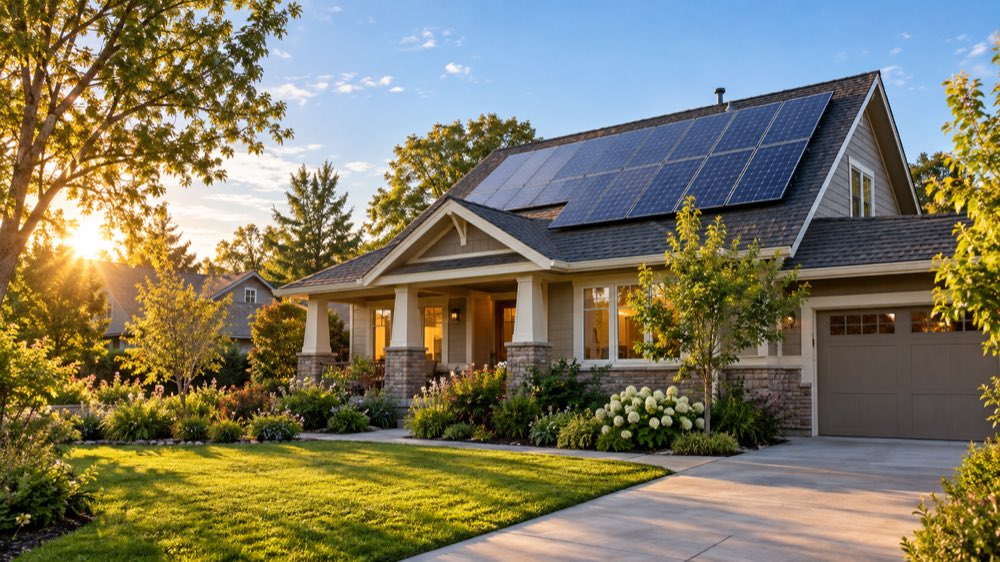
Family home with rooftop solar panels in warm sunlight
Minimizing the impact of humans on the environment is more important than ever. Climate change is a very real threat that is already happening in the world around us. Finding ways to use energy more responsibly is one of the most important things that humankind can do to protect the planet for future generations. One of the most effective ways to do that is through the use of solar energy. Below are six key advantages to harnessing the power of the sun.

1. Solar energy is renewable.

Some resources are finite, meaning that they will eventually run out. For instance, fossil fuels, coal, and other natural resources are only available in a limited amount. Once the supply is gone, there isn’t any more available. The power of the sun, however, can’t be used up. No matter how much solar energy is harnessed, there is always more available. That makes solar power a renewable resource, which is one of the reasons why it is one of the leading energy sources of the future.

2. Solar power is sustainable.

In relation to energy, sustainability refers to the ability to use energy today without negatively impacting the capacity of later generations to meet their own power requirements. When viewed from that perspective, solar power is a sustainable energy resource. Using solar energy today won’t interfere with the ability of people in the future to use the same type of energy to meet their needs.

3. Solar energy is available nearly everywhere.

Some energy sources are limited to a relatively small area. For instance, hydroelectric power, which is typically generated through the use of dams, is usually only capable of serving homes and businesses in the immediate vicinity. People who live in areas that aren’t located close to suitable water sources can’t use this type of energy. Solar energy is different. It is available nearly everywhere on the planet. That means that it can be used anywhere that the sun shines without any geographic limitations.

4. The sun provides clean energy.

Harnessing the power of the sun doesn’t pollute the air or the surrounding environment. That isn’t to say that using solar energy is entirely without emissions. For instance, some emissions are released into the environment when manufacturing and transporting solar panels. In comparison to most other energy methods, however, solar power is extremely clean, with very little impact on the environment.

5. Using solar results in lower energy expenses.

Solar panels typically pay for themselves over time through energy savings. Although these systems can be expensive to install, they significantly lower monthly energy expenses. Some people generate more power than they need. In situations like these, they may be able to sell that power back to the local energy supplier, allowing them to earn money or to receive a credit on their future energy bills.

6. Solar panels produce energy silently.

Capturing power from the sun doesn’t create any noise. This is in contrast to many other power generation methods, which can be quite noisy. For instance, wind turbines are notorious for creating quite a bit of noise. Even though they produce clean energy, they are a lot louder than solar panels, which may be an issue, depending on where they are installed. These are six of the primary advantages of harnessing the power of the sun. Solar energy is renewable, sustainable, and available everywhere. It is a clean energy source that doesn’t produce air pollution or noise pollution. Switching to solar energy can save consumers a lot of money on their monthly power bills, making systems like these a worthwhile investment for homeowners and business owners alike.
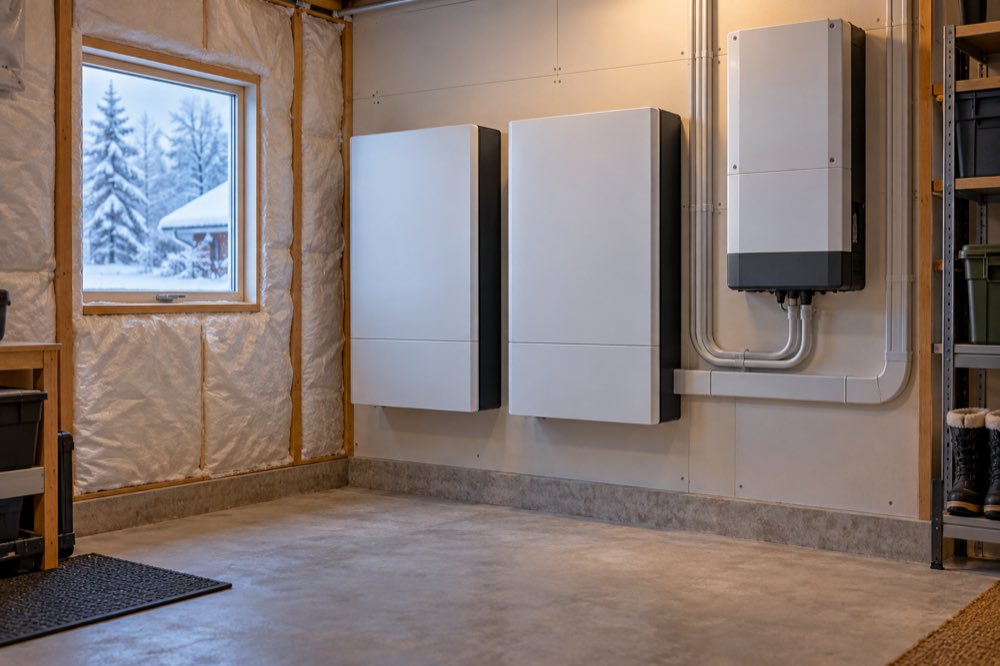
Home solar batteries installed in an insulated utility room during winter

Sunlight will not only provide your solar panels with power, but it will also keep the batteries warm. The problem comes in the winter months when you do not have the hours of sunlight needed to keep your batteries warm. Fortunately, there are steps you can take to keep your solar batteries warm, but the steps do vary depending on the type of battery you have.

Keeping Lithium-Ion Batteries Warm

A lot of solar batteries are lithium-ion because they can be safely installed in your home. This is good for the winter months as your home provides the shelter and warmth that the batteries need. In some cases, you will not have to take any additional steps to protect your batteries in the winter.

However, if your batteries are installed in an area of your home that can still freeze, you need to be careful. The area the batteries are installed in should not become lower than 32°F. These batteries can safely discharge in sub-freezing temperatures, but they should not be charged at these temperatures.

If your batteries are located in a freezing area, you need to place additional insulation around it. This will keep the battery warm in the winter and reduce the risks of sub-freezing charging.

Most of the lithium-ion solar batteries will have a battery management system. These systems can be used to activate external heating sources when the temperature gets too low. There are also some advanced lithium-ion batteries that have internal heaters. You will need to check what type of battery you have and if they have these systems.

Keeping Flooded Lead Acid Batteries Warm

Flooded or wet cell batteries are able to charge at lower temperatures than lithium-ion ones, but they do require more attention in the winter. This is due to the batteries not being installed in your home where the temperature can be regulated. These batteries are kept outdoors because they release hydrogen gas when in use and this can be explosive in concentrations of 4% or more.

To keep these batteries warm in the winter, they need to be placed in a battery box. These enclosures need 2” holes close to the top and bottom to ventilate them. If your box is inside an insulated shed or garage, you will not have to take any additional steps. However, if they are not, you will need to place insulation and thermal mass to stop temperature swings.

If you add insulation, you need at least an inch of space between the battery and the insulation. This allows air to circulate and will keep the temperature even across all the batteries. When these batteries charge, they will generate heat and the insulation keeps this head inside the enclosure.

Keeping Sealed Lead Acid Batteries Warm

These batteries are safe to be installed inside and this will help you regulate the temperature around it. Another good thing about these batteries during winter is that they freeze at lower temperatures than wet cell batteries. However, it is best to check the specs from the manufacturer regarding the minimum charging and discharging temperatures.

If the batteries are outside your home, you need to shelter and insulate them. An insulated enclosure is the best solution as it will keep your battery warm and dry.

During the winter, you need to keep your solar batteries warm to ensure they work as they should. The steps you need to take to do this will depend on the type of battery you have and where the battery has been installed. Battery enclosures are the best solution as they are insulated and made to keep your batteries warm.